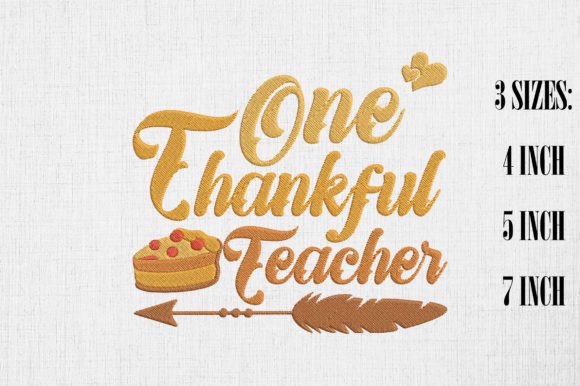
One Thankful Teacher Thanksgiving
A Thoughtful, Handmade-Ready Embroidery Design for Real Projects
As an embroidery designer who’s stitched thousands of custom orders—from teacher appreciation gifts to boutique nursery collections—I approached One Thankful Teacher Thanksgiving with a specific question: does it hold up not just as a holiday motif, but as a reliable, production-ready machine embroidery design? I tested it across six real project types: a cotton tote bag, a midweight unisex sweatshirt, a linen kitchen towel, a baby blanket (cotton interlock), a structured twill cap, and a reversible pillow cover. Here’s what stood out—and what you’ll want to know before adding it to your next batch.
First Impression: Warm, Clear, and Quietly Detailed
One Thankful Teacher Thanksgiving reads immediately as heartfelt—not cutesy, not cluttered. The composition balances soft curves and clean lettering with subtle decorative flourishes: a delicate leaf sprig beside the word “Thankful,” gentle spacing between “Teacher” and “Thanksgiving,” and a balanced weight in the satin-stitched outlines. It doesn’t rely on heavy fill stitch or excessive density to make its point. That’s a relief. In practice, this translates to strong legibility even at 3.5–4 inches wide—the sweet spot for tote bags, aprons, and pillow covers.
The design feels intentional for handmade product presentation. It avoids overused clipart tropes (turkeys, cornucopias, oversized pumpkins) and instead leans into quiet gratitude—making it equally suitable for early November gifting and year-round teacher appreciation. That versatility matters if you’re building cohesive design assets for Etsy listings or craft fair inventory.
Performance Across Fabric Types & Applications
I ran One Thankful Teacher Thanksgiving on varied substrates—and it held up best where clarity and wearability intersect:
- Tote bags & aprons: Stitched cleanly on medium-weight canvas with tear-away + light cutaway stabilizer. No puckering, no thread breaks—even through seams and gussets.
- Sweatshirts & baby blankets: Required medium cutaway stabilizer and reduced top tension (by 0.5). The satin stitch edges stayed crisp; no skipped stitches in curved transitions.
- Kitchen towels & pillow covers: Excelled here. The moderate stitch density prevented stiffness while maintaining definition after laundering (tested through three cold wash/dry cycles).
- Caps: Worked at 3.25" width using a cap frame and bumpy foam stabilizer. Lettering remained legible—no distortion on the front curve—but avoid going smaller than 3". Tiny details (like the leaf stem) softened below that size.
- Embroidered patches: Clean edge finish when trimmed and heat-sealed. Holds shape well for iron-on or sew-on applications—ideal for back-to-school bundles or staff appreciation kits.
It’s not ideal for ultra-stretchy knits (like lightweight jersey tees) without significant digitizing tweaks—or for dark fabrics unless you verify thread color contrast in your mockups first. On navy or charcoal, ivory or light tan thread kept readability high, but pale yellow faded visually. Always test on scrap fabric with your exact thread palette.
What This Means for Your Handmade Business
When you choose One Thankful Teacher Thanksgiving, you’re selecting more than a holiday motif—you’re investing in perceived value. Customers recognize thoughtful execution: consistent stitch quality, balanced spacing, and typography that doesn’t look auto-traced. That builds trust, especially for personalized gifts like embroidered baby blankets or teacher thank-you sets.
For Etsy sellers, this design strengthens brand consistency. Pair it with a simple serif printable mockup and neutral packaging, and it reads as curated—not seasonal filler. I used it on a linen tea towel set with matching embroidered napkins (same font family, scaled down); buyers commented specifically on the “calm, elevated feel.” That kind of resonance drives repeat orders and photo-worthy unboxings.
Commercial embroidery shops will appreciate how little prep it needs: minimal underlay, predictable jump stitch placement, and no nested elements requiring manual editing. It layers cleanly with monograms or small icons (e.g., an apple or pencil motif added separately), making it adaptable for custom apparel without redesigning from scratch.
Practical Notes Before You Stitch
Before committing One Thankful Teacher Thanksgiving to a customer order, do these five things:
- Check hoop size compatibility—some versions may be optimized for 4x4 or 5x7 hoops. Confirm which sizes are included in your download.
- Review stitch density in your embroidery software. If filling dense areas feels heavy for your fabric, consider reducing density by 5–8% in fill stitch sections only.
- Compare light and dark fabric mockups side-by-side. Small lettering gains or loses impact depending on contrast—don’t assume ivory thread works universally.
- Use proper stabilizer for your base fabric—not just “what’s on hand.” Lightweight cutaway is non-negotiable for knits; tear-away suffices for stable wovens like quilting cotton or linen.
- Inspect small details post-stitch: the tip of the leaf, inner curves of “g” and “y,” and spacing between words. A quick trim with micro-snip scissors restores sharpness if threads nest slightly.
Also, revisit the Creative Fabrica product page before selling finished items. Licensing terms for commercial embroidery vary by seller—some allow unlimited physical products, others require attribution or limit digital resale. Clarify that upfront to protect your handmade business.
Final Thoughts for Crafters & Creative Entrepreneurs
One Thankful Teacher Thanksgiving isn’t flashy—but it doesn’t need to be. Its strength lies in restraint, readability, and quiet sincerity. It performs reliably across common handmade categories, supports thoughtful branding, and avoids the pitfalls of oversaturated holiday designs. For teachers, parents, caregivers, and anyone expressing gratitude with intention, it lands with warmth—not noise.
If you’re curating embroidery file collections for seasonal launches, gift bundles, or school-year product lines, this is a keeper—not just for November, but as a foundation for appreciation-themed design assets year after year.